Sunday, March 28, 2021

Dear Mr. President


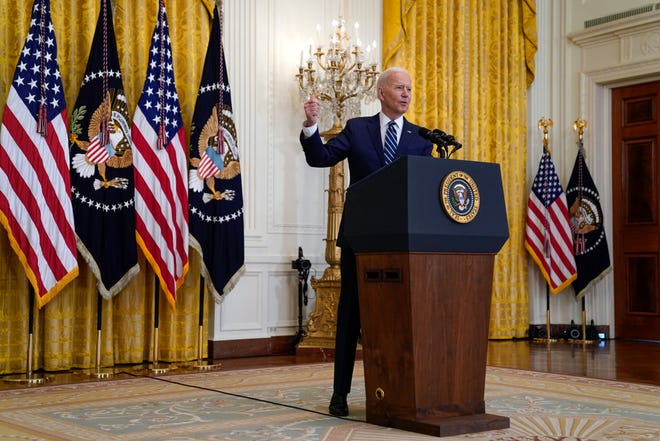
President Joe Biden speaks during a news conference in the East Room of the White House, Thursday, March 25, 2021, in Washington.
Evan Vucci AP -- taken from USA Today
 
Dear Mr. President,

Congratulations on your first news conference this past Thursday.  I could tell that you felt pretty passionately about everything you talked about, and while CJR criticized the media there, saying they'd wasted the opportunity, I did find a few of them asked cogent questions--especially that fellow from Bloomberg.  Your comments to him about your time spent with China's leader, Xi Jinping, revealed to me that you understand the threats facing our own nation and the world from China--its leaders' ideals and policies.  That you're still willing to work with them where you can is frustrating to me, but completely cutting ourselves off from them is likely worse than at least continuing to try.

I need to get this off my chest before I move on, because it's really been bugging me.  The thing about Jamal Khashoggi still bothers me, and I suspect it bothers a lot of other reporters, too.  That the press is hostile with politicians comes as no surprise when their lives are dismissed in the interests of global politics and relationships.  There is plenty of evidence to tie his death back to the Crown Prince; and yet, after all this time, nothing has been done--or at least that's the impression I've gotten.  If it's a mistake in messaging, or a lost message (clearly left unconveyed, since it isn't being touted,) that would be one thing, and that's what I hope it is.  But if we've excused the killing of a reporter by people with whom we're doing business, that's not okay.  Not by any standard worth having, as far as I'm concerned.

Okay.  That said, I am looking forward to the infrastructure bill you're going to announce this week.  It sounds ambitious, which is something we definitely need right now.  I did happen to read something this weekend though that gave me pause, since it deals with biomass burning--the burning of wood pellets for energy.

As it stands, I think there's some pretty wonky math being used to discuss carbon emissions and getting to a place where we're carbon neutral.  From what I read, for example, Europe, who uses the most biomass fuel, calls burning it carbon neutral because they only count the carbon used in the process to create the biomass, and not the burning of it--which doesn't make sense to me.  You can't count one part of the process and say that then the other doesn't count.  That's sort of ridiculous.  In either case, our country supplies a lot of that biomass for energy, and policies regarding it have been left for a few administrations to try and solve and been left in limbo.  Your administration has the chance to finally do something about that.

If you have read science fiction for a long time, you'll often read a common theme over and over again--doing things quickly for short term gains has a cost, but doing things right over the long term creates numerous advantages and gains.  Now, sometimes there just isn't time to do everything right, and you've got to go with what you've got.  But taking the time to do something right seems to be a reward in and of itself.  As an example, if you take the time to ensure that you're creating a bio-diverse and locally inhabited forest, you create an ecosystem that sustains more local wildlife and opportunities for species growth.  But if, say, you introduce plants into an ecosystem where they're not normally grown, they can become a problem--especially if there aren't natural predators that eat those plants or have uses for them.

That last happened in Africa when a non-native bush was brought into the savannahs to help preserve the area and its water.  It certainly helped at first, but over the long term, when a long rainy season happened, those bushes proliferated and started harming the local ecology--starving out local water sources and thereby killing much of the wildlife that lived there.  There weren't animals that fed on the plant, and so it became a problem.  There wasn't a proper balance maintained.

Time and time again we want to rush ahead and do the progressive things because we need to do them to save something--in the case of the climate, ourselves.  But we also need to remember that everything should have a balance.  Cutting down trees to make way for replanting of non-native species of trees that will, in time, just be harvested again for biomass fuel isn't creating more actual forest land, and the funky math we have of saying that it does create more forestland is disingenuous at best.  We need to look at the practices of the logging industry and its corporations and stop rewarding them for finding creative loopholes that allow them to get richer at the cost of losing natural forestlands and local trees and fauna and wildlife.  We have to stop pretending that if we count one part of a process it counts for all of it.  These practices need to stop, Mr. President.  Otherwise we're just making up lies to assuage our greed.

The sad part of that is that we're going to need to help out farmers who are doing those plantings for the payouts, otherwise they're going to lose what little insurance they have in the lands that they've bought and maintained for so long.  That is their family wealth in a lot of ways, and if we start doing the right thing, they're going to have make changes, too.

But I really do believe that if we start doing the right things, we're going to be rewarded for it in the long run.  One last thing on that before I move on: one of the biggest reasons for clearcutting in the world has to do with farming and food production.  This is something that we need to look into, much like some Asian countries are.  If we can find ways to cultivate food using less space, that's probably a good thing, and vertical growth (growing up instead of out,) might be one possible solution to this.  I don't know how viable it is, of course, but I do think it's something we should invest in researching.

Speaking of the climate, I read another article this week about geoengineering.  I hear they're going to be releasing chalk into the stratosphere sometime in July over Sweden to test the efficacy of it helping to cool our temperatures.  I don't know how I feel about these things, but I suppose since we haven't been able to curb our carbon emissions, we've got to try looking at other solutions.  On one hand, I'm excited to see what will happen, and on the other, I'm worried we might create yet another cascading set of problems.  So I guess we'll want to keep an eye on this, Sir.  And maybe prepare for any problems that might occur because of it--you know, put some scientists on the job considering the effects of these experiments.

I was excited to see what you did on Equal Pay Day--acknowledging that there are disparities that need to be addressed still and highlighting them.  I'm also looking forward to seeing what causes your wife chooses to endorse as First Lady of our country.  I've always loved the idea that while the President is doing the work of protecting the interests of the country, their spouse is working to preserve the heart and soul of it.  And since that is something that you ran on, I'm hoping that Mrs. Biden will be as excited and hopeful and giving as you have been and promote a cause that helps remind us of the goodness, kindness, and love that is at the heart of our America.

Yesterday was SWAN Day -- Support Women Artists Now Day.  It makes me happy to know that often marginalized voices have a day to shine--especially when those voices often encourage the kinds of behavior that bring about unity instead of divisiveness.  It was exciting to see that there were two women nominated for Best Director at the Oscars this year, too.  I feel like maybe, hopefully, the message is starting to shine through--that women work just as hard at what they do as men, and that they deserve to be recognized equally, instead of being disparaged as somehow "less than."  It is one of the reasons that I'm so glad that we have Kamala Harris as our Vice-President.  And that you showcased the vibrant and beautiful poetry of Amanda Gorman at your inauguration.  Or that you chose to have a Native American woman as your Secretary of the Interior, Deb Haaland.    Seeing so many diverse people, and women, serving our country in such visible roles is exciting; it makes me feel like maybe the voice of our country will actually start reflecting the voice of the people in it.  And that's no small accomplishment, Mr. President.

Of course, I wouldn't mind seeing some disabled representation there, too, but I'll take what I can get for now.

As Winter fades and Spring starts to settle in here, there are going to be a lot of problems we're going to face, Sir.  We've already begun to see it with the recent mass shootings, and I'd like to offer some thoughts on that.

Taking away guns from people probably isn't the solution, and I know you've got a "holding gun manufacturers liable" bill in the works, but maybe it's time to really consider gun licensing.  The military, for example, doesn't allow people with disabilities or mental problems to join them, because they are operating dangerous technologies and handling sensitive information.  And we don't just let anyone drive a car in this country.  We make sure they know how to use and operate a car.  They take a test, and they are given a license that says they've passed those tests.  I think it's time that we created a gun license program to ensure that people who do own guns know how to use them safely, and properly store them and take care of them.  Many gun owners already know these things, but the idea at the beginning of our country was that militias would be ensuring these things on a local level--something we don't really have these days.

So if we want to keep the spirit of the framers alive--that ability for people to rise up against an unjust government if it becomes warranted, I feel like we also need to ensure that the ideal of the militia is maintained in some way, too.  National licensing isn't necessary, per se.  We could leave it up to the state governments to issue licenses and determine the criteria needed for obtaining one--how often they should be tested and renewed, etc.  We could offer national guidelines, of course, like the CDC does for health directives, but this takes away the stigma of the federal government having a national registry of licensed gun owners, for example.  Still, licensing would help, I think, to promote the safe use of guns.  That doesn't mean, of course, that we won't still have mass shootings, but it does mean we won't be giving licenses to people who aren't qualified to use guns.  Make federal funding contingent upon gun licensure programs in each state.

And look--I know my ideas are pretty simplistic, but I'm trying to compromise between ideologies that have made the gun debate an ongoing disaster for generations.  And we've tried banning things, and in some cases that has worked (like extended magazines, for instance.)  But it hasn't stopped the killings and the mass shootings.  And while there are some out there who don't care for guns at all, (I, myself, don't really care for them,) there are others who feel that part of America's identity is the freedom to own a gun.  I'm just trying to find a middle-ground, and I really think licenses and testing will help.  Leaving it in the hands of the states, to me, is important, since it was that idea of the state militia that was part of the wording of the Constitution in the right to keep and bear arms.  But requiring it for federal funding is also important to me, as it stipulates that we, as a nation, believe that responsible gun ownership is necessary to the continued preservation of it.  And I think that's something the framers of our country would approve of, too.

One last thing before I head off for today, Sir.  Have you met Katie Porter?  She's our House Representative here for our Orange County district, and she's amazing.  She's working hard for all of us, and she really cares about the people of this country and our district, too.  If you get a chance, please invite her over for a chat some time and hear her out.  I'm just...really impressed with her work ethic and her desire to do right by the American people.  I also love that she gets to give "Mom" looks to people who try to pretend like what they're saying isn't a lie.  I think, sometimes, we need more people like her in government.

And with that, I'll be going, Sir.  I hope you have a lovely second week of Spring, and please consider supporting that legislation about Daylight Savings Time.  The switching of the clocks, as amusing and time-honored a tradition as it is, needs to go.

Until next week, then, stay safe and keep moving forward.


~~ Jenni

P. S. So last week I mentioned that someone close to me had gotten COVID-19.  They are, thankfully, on the recovering end of it, and I am grateful for it more than I can express in words.  I guess I just wanted to share that--to let you know that things are better today than they were last week.  But also to remind people that the pandemic is still out there, and it's still happening.  The people I love were lucky; not everyone will be.  So please keep pushing the messages about masking, and washing hands, and being kind and respectful to our fellow human beings.  This isn't over yet, and we can't start acting like it is; or a lot more people might die.  And I wouldn't wish that agony, of losing a loved one, on anyone.

Saturday, March 27, 2021

From Winter to Spring


This week I have been continuously amazed and awe-inspired by a woman from Spain named Priscilla Hernandez.  She writes music; she sings; she writes her own lyrics; she draws and paints.  She makes many of her own costumes, and she is simply a beautiful person.  This song in particular I helped inspire the title for, and it and another of her songs, "Longing to Bloom" have really incapsulated my feelings of late.

With the vaccination effort ongoing, there is this new sense of hope for what is to come, and with Easter just around the corner as the flowers are starting to bloom and storms are throwing themselves against our shores, it feels like there is an overall awakening as from a long, deep slumber.

Today is also SWAN Day -- Support Women Artists Now Day, and while I can think of several women artists that inspire me, I've felt as though Priscilla has been calling me the most this week to share her work, her beauty, and her hope with the world.

I think hope is something all of us could use right now; so, wherever you are, whatever you're doing, I wish you a hopeful spring full of blossoming inspiration, laughter, new friends, and new beginnings--the memories of those we've lost over the past year a touchstone that can grow our sorrows from pain into something that brings peace.

If you'd like to hear more of Priscilla's music, check out her Youtube Page, consider joining her Patreon, and if you're as enchanted by her work as I am, please look up her work on Bandcamp where you can buy her music!

Friday, March 26, 2021

Causes to Celebrate: Popular Information

“A popular Government, without popular information, or the means of acquiring it, is but a Prologue to a Farce or a Tragedy; or, perhaps both.” — James Madison

I love this particular quote which is the tagline and the first thing you see when you visit the About page of Popular Information.  It reminds us of the importance of getting, not just news, but actual information that helps us make informed decisions, rather than getting the story that a multi-billion dollar news conglomerate wants us to hear.  As Judd Legum, the author of Popular Information, says:

You are not a spectator and democracy is not a game. But so much of what is written about politics treats you that way. That’s why I created Popular Information. It is daily news and analysis that respects you as citizen. You won’t just learn about who is up and who is down. You’ll get in-depth information and perspective on the things that really matter.

I've been watching Judd's progress for a few years now, and it's telling that much of his reporting focusses on issues where there is a lot of hype, disinformation, or outright lying going on.  He holds businesses and politicians accountable for the things that they say and do, and his work has changed the way that those people and companies do business because of public outcry and public sentiment.  If I had to put a name to what he does, I'd say that he's a leading voice in technological activism.  And the best part about his work is that he's been in the trenches and knows how the business of politics works.  He served on a presidential campaign and even ran for office in his own state.  So while many of us have never done more than host a party or two, he's seen from the inside how stories are told about the people that are running our government, and he knows how the money flows.

One of his most recent successes came after the January 6th failed coup attempt where he began pointing out companies that supported candidates who themselves supported the actions of the protestors that day.  And when those companies were called out on their support, they started pulling back their donations.  It cost the Republican Party a lot of money, and while those donations are slowly but surely returning now that the public and national news cycle has moved on from the incident, Popular Information continues to watch that money flow.

This is a really important thing, too, as money is a big part of politics these days, sadly.  Instead of local issues and small-town priorities, our local, state, and national governments are riddled with monetary donations to campaigns in return for candidate cooperation once they've won office for issues that those donors believe to be important.  It's a sad truth that is part of our current democratic process, and one that I'd love to see changed, but it's better by far than an autocratic dictatorship where there's no transparency at all in the process.  At least this way we can, more or less, see where the money is coming from and make choices based on what we believe is good.  (Part of the PAC process is to help hide the names of  individual corporate donors, which is problematic as far as I'm concerned.  If you're giving money to someone, you're endorsing their policies; and if you're not willing to admit to that, then maybe there's a problematic reason for it.)

What I also like about Popular Information is that it isn't driven by news cycles, but rather by data, something that in recent years is an amazing tool for helping people to become more aware of what's going on in the world around them.  This data-driven approach is something that I believe is important; it helps us to find trends and see where the words don't match the actions.  And that's something that is integral to growth--both on a personal level, but also on a national and global perspective, as well.  We need to know when we're making mistakes so that we can change.

And it is that hope for change, that belief that data and accountability are information worth sharing, that makes Popular Information a cause worth celebrating.

Thursday, March 25, 2021

Causes to Celebrate: bell¿ngcat

Continuing in the vein of investigative journalism, I wanted to share with you a journalism site that I found sometime in late 2019 by way of a podcast.  The podcast had nothing to do with the site, but the person who did the podcast was also an investigative journalist for the site--and that site is Bellingcat; (the spelling above is their marketing version of their name.)


From its inception in July of 2014, Bellingcat has been a place where investigative journalists can work together and crowdsource information on a variety of things--from state-sponsored chemical warfare (Syria and Russia,) to our most recent failed coup here in America.  If something bad is happening somewhere in the world, Bellingcat seeks to help people and journalists uncover more information about it.

What started as a one-man operation by Elliot Higgins expanded to the company it is today.  It was first funded by a Kickstarter campaign and now receives numerous grants and gifts along with public donations.

The Columbia Journalism Review sat down to interview him in early 2015 shortly after his successful crowdfunding campaign and launch of the platform to talk to him about the work he was doing and the Bellingcat he was hoping to create.  Here's a small snippet of his hopes for Bellingcat's future:
What will the site become if it fulfills your ultimate ambition for it? Ultimately a huge global network of investigators exploring a wide range of topics, from conflict to corruption, with transferable skills and tools that can be quickly brought to bear, regardless of where a story is occurring in the world. I want the very idea of open-source information existing to put the fear of God into the sort of people who have something to hide, because they’ll know there’s a network of people primed to use it to expose what they’re trying to keep hidden.
And here is what the Bellingcat site of today says of their work:
Bellingcat is an independent international collective of researchers, investigators and citizen journalists using open source and social media investigation to probe a variety of subjects – from Mexican drug lords and crimes against humanity, to tracking the use of chemical weapons and conflicts worldwide. With staff and contributors in more than 20 countries around the world, we operate in a unique field where advanced technology, forensic research, journalism, investigations, transparency and accountability come together.

 All in all, their seven official years of operation have been a success earning them global recognition and awards.  But the appeal to Bellingcat, for me, wasn't simply the journalism that they do, but also their ability to use technology to investigate various sources of information--from pictures to videos, and even publicly available satellite data.  They also offer courses and training in how to do these things for anyone willing and able to pay for it, helping to defray some of their operating costs which allows them to use more of their income on conducting actual investigations.

This desire to share their knowledge is incredibly important to me--the idea of empowering citizen journalists (that's you and me,) to be part of creating information sources that could, potentially, be used for the good of all of us; that, to me, is pretty impressive.  And that's part of what has made Bellingcat so successful--their ability to crowdsource information, getting local people to share what they see, what they hear, and what they're being told.  All of this combined can help to tell a more truthful account of something than merely one person's view.  And that is the true beauty of what Bellingcat offers to its viewers and to fellow journalists and media organizations--a bigger picture.

As I have iterated all this week, it really is important for us to have a diverse and free press--to have local and cultural voices sharing with us their insight, knowledge, and understanding in the stories that they tell, and with Bellingcat's international collective of journalists, they help to add to our greater understanding of events all over the world.  Not only that, but they are also helping to hold accountable those parties that do bad things in the world and are also ensuring that sources of information are not destroyed, but preserved for the future--which is incredibly important for future cases and investigations which may be able to use their data to hold people accountable for their actions.  And that is why I believe Bellingcat is a cause worth celebrating.

Wednesday, March 24, 2021

Causes to Celebrate: International Consortium of Investigative Journalists

People in power seem bent on abusing that power far more often than they are seen using that power for good ends.  Often they perpetuate systems and ideas that benefit them to the detriment of those of us who have little in the way of power in the world.  And while it would be a nice fiction to believe that all people in the world are truly altruistic in nature, sadly there is far more evidence to the contrary.  But when it comes to speaking truth to power, there are few ways that this can be done.  In the past there were great wars and revolutions that did a great deal to change the status quo, but ultimately those who have power have retained it--often illegally or by outright lying.  And while we have a robust legal system, this has also, often, been gamed to benefit those in power rather than serving the needs of the people of the world.  So where, then, can we turn?  Where can we seek redress to the ills and harms that have befallen us through no fault of our own?  I present to you once more the media, and one non-profit organization in particular: the International Consortium of Investigative Journalists.


From tax evasion to medical malpractice, the ICIJ has been speaking truth to power for nearly 24 years.  In 2017 they split from the foundation that started them to form this non-profit in the hopes that they could have a broader reach and a larger impact.

Their stories have uncovered a hidden world of grift, cheating, kidnapping, extortion, and money laundering that spans the globe, and it isn't easy work.  Often the reporters on the ground are putting their lives in danger, and those who bring leaks to the organization may be party to reprisals should their involvement be found out.  And because this is an organization run by journalists, the information and the stories that they provide to the rest of the local, national, and international media have been vetted and investigated thoroughly.  This dedication to the truth has garnered them several awards, including the coveted Pulitzer Prize for their Panama Papers Project.

Here is just one example of some of the work they're doing to help inform the public about the work they do:


While much of their work remains behind the scenes, evidence of their findings have prompted several countries to hold hearings to make law breakers accountable.  And while sadly we have seen little in the way of fallout from some of their work, there have been modest gains with the implementation of new laws, court cases, and access to information that was and has been hidden.  Having that information is an invaluable tool and resource to the world, and it is one of the many reasons that I believe the work these journalists are doing is so important.

As I stated previously this week, we often forget the details and that is to our own detriment.  So having sources of information available to us that we and the media can use to hold the powerful accountable--at least in the eyes of the public, if not the courts or the legislature, is immensely powerful itself.

What I find saddest about their work is that much of it goes unreported here in America and in the mainstream media, which is why I keep an eye on their work and read over it from time to time to gain insights that might not otherwise be available.  And that is why I am calling attention to their work today in the hope that you'll take a look at it for yourself, as well.  Because I truly do believe that the International Consortium of Investigative Journalists is a cause worth celebrating.

Tuesday, March 23, 2021

Causes to Celebrate: Columbia Journalism Review (CJR)

So if I had to name one place that helps me keep track of news media in all its many forms, I would have to point to the Columbia Journalism Review.  CJR was essential during the past election as it helped to bring to light stories from all parts of the country--not just those that reflected my own views.  It was just as important to me to understand news journalism from a local standpoint as it was to understand it from national and international perspectives, and CJR really helped with that.  In essence, they are a news site about news sites--talking about local trends in journalism, noting where local journalism is dying, and where new opportunities are being found.  They highlight some common threads in journalistic writing, and point to where they've been more, or less, helpful to the overall conversations taking place around just about any issue you can think of.  And I believe that it is just as important to understand the forces and voices that bring us the news as it is to get that news.


Being informed about these trends, and hearing from those critiquing their own fellow journalists is something I really find to be helpful.  It lets me know where conversations have come from and where they were started, and whether or not those conversations are actually useful to have and then also helpful to the overall discussion.  CJR informs me about what good questions are and where local and national news teams are failing to ask them; they also highlight journalism sources that are looking to deepen our conversations and create more thoughtful and insightful reporting instead of just looking for clicks or the latest hype.

Their reporting during the election centered on small towns in America and the issues that were on the minds of various swathes of people--from the east coast to the west.  It was invigorating to see what the concerns of other communities were--to understand their points of view and to consider them when making my own decisions.  And when the pandemic began to really hurt the media industry as a whole, it was good to see those trends--to know that a lot of local journalism was being replaced by big money investment companies that might be more interested in shilling propaganda rather than unvarnished accounts of events.

Now, to be clear, most news organizations have a bias and an agenda, and while some of them are more open about it than others, it's important to understand those biases so that you can decide if the news is actually important or just someone's own calculated views to slant the stories in a way that will get the responses they want.  And yes; that does actually, and unfortunately, happen.

Case in point, when the news about George Floyd started showing up, and as local protest movements were going on, many newspapers stopped people of color from covering those stories out of fears of bias or ...something.  But who better to cover those stories?  Why not allow it?  Many journalists of color were disheartened and disappointed that, while there was a national movement to reconcile our biases and bring more diverse views to bear, local and national news organizations were often more intent on stymying those impulses.  Learning about that through CJR colored (hah) my own perceptions of the news and the way its reported to us and informed me about a lot of work-place biases that have become ingrained in our national institutions--including the media.  And that was really important to know and to understand, because if you're not getting a local or a community-based story, then is the news really a good representation of what's going on?  Can we actually have a conversation if our sources don't actually understand the politics and local sentiment where the stories are coming from?  My sincere belief on this is that, no; we cannot.

So this is why CJR is so important; it talks about these issues and strives to ensure that our news industry is actually trying to do good work for the people (and pointing out when it doesn't.)  And that is why I think it is both so vital for all of us and also a cause worth celebrating.

Monday, March 22, 2021

Causes to Celebrate: Press Freedom Defense Fund

Congress shall make no law respecting an establishment of religion, or prohibiting the free exercise thereof; or abridging the freedom of speech, or of the press; or the right of the people peaceably to assemble, and to petition the Government for a redress of grievances.

That is the first amendment to the United States Constitution, part of a group of amendments known as the Bill of Rights.  It is from this first amendment that we are granted what the framers of our country believed to be the most important of freedoms--religion, speech, press, and peaceful petition to redress grievances.

This week I wanted to highlight those causes and organizations that continue to ensure that we are able to have a free press here in our country, and today I wanted to speak first and foremost about those people seeking to defend journalists and photographers who, every day, put their lives on the line to bring us information that is vital to our remaining informed citizens, able to think critically about the decisions that effect all of us.  And so I want to begin with an organization with one simple aim: to defend the freedom of the press--the Press Freedom Defense Fund.

Much of the freedom that our press currently enjoys stems from a group of papers circulated in England during the early 1700's known as the Cato Papers.  These ideas influenced the framers of the Constitution, with Virginia being the first state to formally protect press freedoms in their 1776 Declaration of Rights which states, "The freedom of the Press is one of the greatest bulwarks of liberty, and can never be restrained but by despotic Governments."

And that is what the Press Freedom Defense Fund seeks to protect--those rights which our founders believed were so important they named them in the very first amendment to our Constitution.  Rather than try to express the fund's ideas in words, however, I'll let their press video speak for itself.


Those who founded our country believed that a free press was vital to protecting the integrity of our government.  They also knew that it was one of the few ways that people could get information that was necessary to making good, sound decisions for not only their own future, but that of our country as well.  And while there may be those who view the press as an enemy of "truth," I believe that it is only because of the press that we are able to view the many differences that make up our own individual truths.  I also believe that the press is one of the ways that people can hold those in power accountable for their actions--by recording what is said and what is done and making that information available to people.  Because let's face it; many of us forget what we ate just a week ago, much less remember what politicians, businessmen, and our fellow people have said.  And having that information available--having those records in a public forum, is so important for enabling us to make decisions about who our leaders are, and what we believe they should be--among so many other things.  And while the press may not always get it right (after all, they're people who make mistakes just like you and me,) they help us put into perspective those things which we hold to be most important.

And that is why today I am grateful that the Press Freedom Defense Fund exists--to ensure that one of our most basic constitutional rights is being protected and defended.  And that is why I am sharing their organization as a cause worth celebrating.